| |
Author |
Title+ |
Price |
Buy Now |
|
 |
Subhadra Desai |
Music in Valmiki's Ramayana |
$115.49 $86.62 |
 |
| The literary and cultural heritage of the Ramayana and Indian classical music are both living traditions and key constituents of the Indian identity. It is indeed impossible to imagine an India, of the past, present or future, without either. Reference to this musical tradition in the Ramayana, the earliest literary work in classical Sanskrit, is therefore a propitious context in which a composite legacy of Music-Literature may be examined. Ramayana has a fundamental association with music. The... |
 |
Amrita Priyamvada |
Encyclopaedia of Indian Music |
$192.49 $144.37 |
|
| This book contains vital information on Indian Music, eminent musicians and musicologists in the field of music. The chapters portray the different facets of the theory of music, the tradition of music and its performance, the science of music, the concept of voice and rhythm, the dance in its many splendors. In total, these chapters cover a wide range of music and performing arts. An attempt has been made hereinto study the Gharana and schools in Indian music.
Each chapter deals with a... |
 |
M.C. Joshi |
Early Classical Art of South Asia (Set 2 Vols.) |
$320.99 $240.74 |
|
| The present volume 'Early Classical Art of South Asia' is edited by Prof. M.C. Joshi and Dr. D.P. Sharma. The period of Gupta dynasty begins around 319 A.R ends up to 578 A.D. The art of Gupta period has often been referred to as the classical art of early South Asia. The art of Gupta period was characterized by a sensitivity modeled body from a severity of expansion and dominant spiritual purpose.
During Gupta Age there was all-round development particularly in fine arts-literature both... |
 |
Shruti Jauhari |
Elements of Hindustani Classical Music |
$32.49 $24.37 |
|
| Hindustani classical music, a jewel in the crown of the Indian musical tradition, has become increasingly popular in South India and abroad over the last few decades. This book attempts to present a detailed and comprehensive discussion of the fundamental concepts and aspects of Hindustani classical music. It begins with an account of the history and evolution of Hindustani classical music by taking up developments in a chronological order. It explains a number of terms and processes involved... |
 |
S.R. Sarma |
Scientific Literature in Sanskrit: Papers of the 13th World Sanskrit Conference (Vol. 1) |
$48.49 $36.37 |
|
| David Pingree and G. Jan Meulenbeld have made us aware of the enormous volume and the astonishing diversity of Sanskrit literature on Jyotihsastra and Ayurveda respectively through their monumental works, Census of the Exact Science and History of Indian Medical Literature. Literature on other scientific subjects, though not so stupendous, is still very large. This rich diversity of Sanskrit scientific literature is reflected in the papers presented in Section 8 on Scientific Literature of the... |
 |
Birgit Abels |
The Harmonium in North Indian Music |
$12.99 $9.74 |
|
| The harmonium holds an ambiguous reputation in India as well as in its "home continent" of Europe. There is an abundance of clear statements made by distinguished Indian musicians, theoreticians and also politicians who time and again would decry the instrument. Rabindranath Tagore's famous description of the harmonium as "that bane of Indian music" is just one example. And yet, the harmonium is arguably the instrument most widely used for accompanying the foremost medium of North Indian... |
 |
Ganesh Umakant Thite |
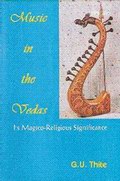
Music in the Vedas: Its Magico-Religious Significance |
$41.99 $31.49 |
|
| In this book an attempt is made to study the vedic music as a magico-religious phenomenon. Music is believed to be either a power-substance or a means to please the gods. Music can attract gods and make them do according to the desires of musicians or it can please gods and then the gods will grant the desired results to the musicians. A musician can get the desired results with the help of music without the help of gods also. Music is useful in order to get rain, food, cattle, long life,... |
 |
Geetha Rajagopal |
The Celestial Nagasvaram: Origin, Myths, Reception and the Maestros |
$75.49 $56.62 |
|
| Classical Musical Instruments from India, No. 2Nagasvaram, world’s loudest non-brass acoustic instrument, is known as mangala vadyam (auspicious instrument), and raja vadyam (king of all instruments). This popular wind-group musical instrument is well known all over the south Indian states, more specifically in Tamil Nadu. Its origin is associated with the Thiruvarur Temple and its legacy continued all through the Pallavas, Colas, Pandyas, Nayakas, and Marathas. It has imprinted its sheen... |


 Follow us on Twitter


